Play Now
I made this ‘game’ in 2014, literally from Scratch, based on the physics of gravity.
Click the green flag to start.
A satellite is orbiting the planet. It has four thrusters for manoeuvring.
You need a keyboard for this.
- Fire the thrusters using the four Up/Down/Left/Right arrow keys. (See below: action and reaction.)
- Try to maintain a safe orbit, without crashing into the planet, or getting lost in outer space!
- Optional controls: Trace orbit with pen [u]p [d]own [c]lear. [g]row or [s]hrink the size (not mass) of the planet.
- Experiment with the sliders to vary the effect of gravity strength ‘G’ and planet mass ‘M’. Gravity is so weak that we only notice it with massive objects like planets. Actual value of G = 0.0000000000667384 (SI units).
How it works
The original is at https://scratch.mit.edu/projects/824757/
See inside how it works here.
The Satellite object runs an endless loop to update its position. The Planet object has a method that responds to ‘crash’ events!
It is a simulation of Isaac Newton’s laws:
F = m a = G M m / d2
The satellite motion comes from the acceleration ‘a’, caused by the gravity force ‘F’, which depends on its distance ‘d’ from the centre of the planet. The direction of acceleration is always towards the centre. That’s called an ‘inverse square law’.
The mass ‘m’ of the satellite does not affect the orbit because it appears on both sides of the equation. (But why inertial mass = gravitational mass?)
The simulation computes the change in position of the satellite in small time steps. (It’s a ‘finite difference’ method to approximate the underlying vector calculus.)
- velocity is rate of change of displacement (position)
- acceleration is rate of change of velocity
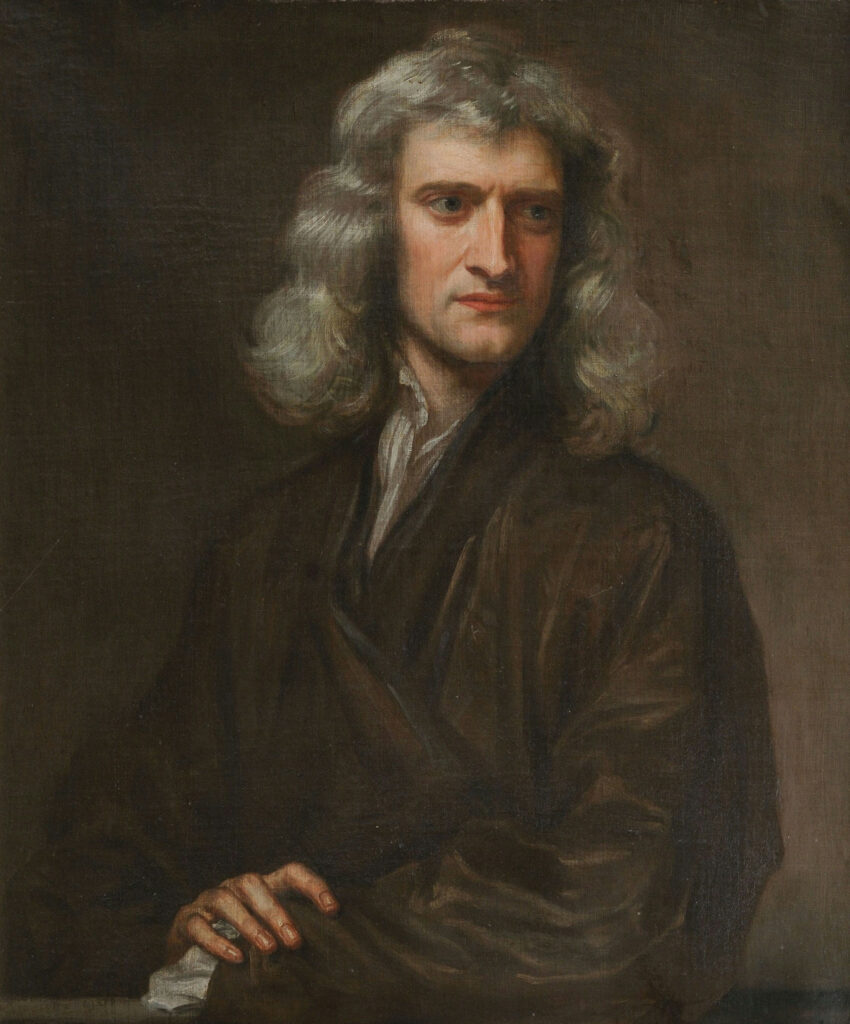
Isaac Newton
The three laws of motion were first compiled by Isaac Newton in his Philosophiæ Naturalis Principia Mathematica (Mathematical Principles of Natural Philosophy), first published in 1687.
- An object will not change its motion unless a force acts on it (First Law).
- The force on an object is equal to its mass times its acceleration (Second Law).
- For every action, there is an equal and opposite reaction (Third Law).
Newton showed that these laws of motion, combined with his law of universal gravitation, explained Kepler’s laws of planetary motion.
Motivation
In 2014 I was working as a software engineer, supporting an Educational project at the European Space Agency, using some tools like Orekit.
At the same time I was also thinking about how to bring physics and computing to younger students in the context of STEM.
Then I discovered Scratch, a fun visual programming environment from MIT, and was inspired to see what could be done with the application of some school Physics.